

Extracorporeal membrane oxygenation
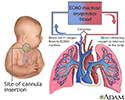
ECMO; Heart-lung bypass - infants; Bypass - infants; Neonatal hypoxia - ECMO; PPHN - ECMO; Meconium aspiration - ECMO; MAS - ECMOExtracorporeal membrane oxygenation (ECMO) is a treatment that uses a pump to circulate blood through an artificial lung back into the bloodstream of a very ill baby. This system provides heart-lung bypass support outside of the baby's body. It may help support a child who is awaiting a heart or lung transplant.
WHY IS ECMO USED?
ECMO is used in infants who are sick due to breathing or heart problems. The purpose of ECMO is to provide enough oxygen to the baby while allowing time for the lungs and heart to rest or heal.
The most common conditions that may require ECMO are:
- Congenital diaphragmatic hernia (CDH)
- Birth defects of the heart
- Meconium aspiration syndrome (MAS)
- Severe pneumonia
- Severe air leak problems
- Severe high blood pressure in the arteries of the lungs (PPHN)


It may also be used during the recovery period after heart surgery.
HOW IS A BABY PLACED ON ECMO?
Starting ECMO requires a large team of caregivers to stabilize the baby, as well as the careful set-up and priming of the ECMO pump with fluid and blood. Surgery is performed to attach the ECMO pump to the baby through catheters that are placed into large blood vessels in the baby's neck or groin.
WHAT ARE THE RISKS OF ECMO?
Because babies who are considered for ECMO are already very sick, they are at high risk for long-term problems, including death. Once the baby is placed on ECMO, additional risks include:
- Bleeding
- Blood clot formation
- Infection
- Transfusion problems
Rarely, the pump can have mechanical problems (tube breaks, pump stops), which can harm the baby.
However, most babies who need ECMO would probably die if it were not used.
References
Ahlfeld SK. Respiratory tract disorders. In: Kliegman RM, St. Geme JW, Schor NF, Blum NJ, Shah SS, Tasker RC, Wilson KM, eds. Nelson Textbook of Pediatrics. 21st ed. Philadelphia, PA: Elsevier; 2020:chap 122.
Chung DH. Pediatric surgery. In: Townsend CM Jr, Beauchamp RD, Evers BM, Mattox KL, eds. Sabiston Textbook of Surgery. 21st ed. St Louis, MO: Elsevier; 2022:chap 67.
Patroniti N, Grasselli G, Zanella A, Pesenti A. Extracorporeal support of gas exchange. In: Broaddus VC, Ernst JD, King TE, et al, eds. Murray and Nadel's Textbook of Respiratory Medicine. 7th ed. Philadelphia, PA: Elsevier; 2022:chap 138.
Stork EK. Therapy for cardiorespiratory failure in the neonate. In: Martin RJ, Fanaroff AA, Walsh MC, eds. Fanaroff and Martin's Neonatal-Perinatal Medicine. 11th ed. Philadelphia, PA; Elsevier; 2020:chap 70.