

Hangover treatment
A hangover is the unpleasant symptoms a person has after drinking too much alcohol.
Symptoms can include:
- Headache and dizziness
Dizziness
Dizziness is a term that is often used to describe 2 different symptoms: lightheadedness and vertigo. Lightheadedness is a feeling that you might fai...
 ImageRead Article Now Book Mark Article
 -
Nausea
Nausea
Nausea is feeling an urge to vomit. It is often called "being sick to your stomach. "Vomiting or throwing-up forces the contents of the stomach up t...
 ImageRead Article Now Book Mark Article
 -
Fatigue
Fatigue
Fatigue is a feeling of weariness, tiredness, or lack of energy.
 ImageRead Article Now Book Mark Article
 - Sensitivity to light and sound
- Rapid heartbeat
-
Depression, anxiety and irritability
Depression
Depression may be described as feeling sad, blue, unhappy, miserable, or down in the dumps. Most of us feel this way at one time or another for shor...
 ImageRead Article Now Book Mark Article
Tips for safe drinking and preventing a hangover:
Safe drinking
Alcohol use involves drinking beer, wine, or hard liquor.
Read Article Now Book Mark Article- Drink alcohol-containing drinks slowly and on a full stomach. If you are a small person, the effects of alcohol are greater on you than on a larger person.
- Drink alcohol-containing drinks in moderation. Women should have no more than 1 drink per day and men no more than 2 drinks per day. One drink is defined as 12 fluid ounces (360 milliliters) of beer that has about 5% alcohol, 5 fluid ounces (150 milliliters) of wine that has about 12% alcohol, or 1 1/2 fluid ounces (45 milliliters) of 80-proof (40% alcohol) liquor.
- Drink a glass of water in between drinks containing alcohol. This will help you drink less alcohol and decrease dehydration from drinking alcohol.
Dehydration
Dehydration occurs when your body does not have as much water and fluids as it needs. Dehydration can be mild, moderate, or severe, based on how much...
 ImageRead Article Now Book Mark Article
 - Avoid alcohol completely to prevent hangovers.
If you have a hangover, consider the following for relief:
- Certain measures, such as fruit juice or honey, have been recommended to treat a hangover. But there is very little scientific evidence to show that such measures help. Recovery from a hangover is usually just a matter of time. Most hangovers are gone within 24 hours.
- Electrolyte solutions (such as sports drinks) and bouillon soup are good for replacing the salt and potassium you lose from drinking alcohol.
- Get plenty of rest. Even if you feel good the morning after heavy drinking, the lasting effects of alcohol reduce your ability to perform at your best.
- Avoid taking any medicines for your hangover that contain acetaminophen (such as Tylenol). Acetaminophen may cause liver damage when combined with alcohol.
References
Finnell JT. Alcohol-related disease. In: Walls RM, ed. Rosen's Emergency Medicine: Concepts and Clinical Practice. 10th ed. Philadelphia, PA: Elsevier; 2023:chap 137.
O'Connor PG. Alcohol use disorders. In: Goldman L, Cooney KA, eds. Goldman-Cecil Medicine. 27th ed. Philadelphia, PA: Elsevier; 2024:chap 364.
-
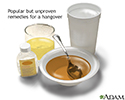
Hangover remedies - illustration
Relief of a hangover can be obtained by taking over-the-counter-pain-relievers, drinking plenty of water, eating soup and foods that contain fructose, and resting.
Hangover remedies
illustration
Review Date: 5/19/2025
Reviewed By: Jacob Berman, MD, MPH, Clinical Assistant Professor of Medicine, Division of General Internal Medicine, University of Washington School of Medicine, Seattle, WA. Also reviewed by David C. Dugdale, MD, Medical Director, Brenda Conaway, Editorial Director, and the A.D.A.M. Editorial team.
 All rights reserved.