

Fish tapeworm infection
DiphyllobothriasisFish tapeworm infection is an intestinal infection with a parasite found in fish.
Causes
The fish tapeworm (Diphyllobothrium latum) is the largest parasite that infects humans. Humans become infected when they eat raw or undercooked freshwater fish that contain fish tapeworm cysts.
The infection is seen in many areas where humans eat uncooked or undercooked freshwater fish from rivers or lakes, including:
- Africa
- Eastern Europe
- North and South America
- Scandinavia
- Some Asian countries
After a person has eaten infected fish, the worm larva begins to grow in the intestine. Larvae are fully grown in 3 to 6 weeks. The adult worm, which is segmented, attaches to the wall of the intestine. The tapeworm may reach a length of 30 feet (9 meters). Eggs are formed in each segment of the worm and are passed in the stool. Sometimes, parts of the worm may also be passed in the stool.
The tapeworm absorbs the nutrients from the food that the infected person eats. This may lead to vitamin B12 deficiency and anemia.
Vitamin B12
Vitamin B12 is a water-soluble vitamin. Water-soluble vitamins dissolve in water. After the body uses what it needs of these vitamins, leftover amo...

Symptoms
Most people who are infected have no symptoms. If symptoms do occur, they may include:
-
Abdominal discomfort or pain
Abdominal discomfort or pain
Abdominal pain is pain that you feel anywhere between your chest and groin. This is often referred to as the stomach region or belly.
 ImageRead Article Now Book Mark Article
 - Diarrhea
- Weakness
- Weight loss


Exams and Tests
People who are infected sometimes pass segments of worm in their stools. These segments can be seen in the stool.
Tests may include:
-
Complete blood count, including differential
Complete blood count
A complete blood count (CBC) test measures the following:The number of white blood cells (WBC count)The number of red blood cells (RBC count)The numb...
 ImageRead Article Now Book Mark Article
Differential
The blood differential test measures the percentage of each type of white blood cell (WBC) that you have in your blood. It also reveals if there are...
 ImageRead Article Now Book Mark Article
 - Blood tests to determine the cause of anemia, if present
- Vitamin B12 level
-
Stool exam for worm eggs and parasites
Stool exam
Stool ova and parasites exam is a lab test to look for parasites or eggs (ova) in a stool sample. The parasites are associated with intestinal infec...
 ImageRead Article Now Book Mark Article
Treatment
You will receive medicines to fight the parasites. You take these medicines by mouth, usually in a single dose.
The medicine of choice for tapeworm infections is praziquantel. If needed, your health care provider will prescribe vitamin B12 injections or supplements to treat vitamin B12 deficiency and anemia.
Outlook (Prognosis)
Fish tapeworms can be treated with a single treatment dose. There are no lasting effects.
Possible Complications
Untreated, fish tapeworm infection may cause the following:
- Anemia caused by vitamin B12 deficiency (megaloblastic anemia)
Megaloblastic anemia
Anemia is a condition in which the body does not have enough healthy red blood cells. Red blood cells provide oxygen to body tissues. There are man...
 ImageRead Article Now Book Mark Article
 -
Intestinal blockage (rare)
Intestinal blockage
Intestinal obstruction is a partial or complete blockage of the bowel. The contents of the intestine cannot pass through it.
 ImageRead Article Now Book Mark Article
When to Contact a Medical Professional
Contact your provider if:
- You have noticed a worm or segments of a worm in your stool
- You have symptoms of anemia
- Any family members are diagnosed with a fish tapeworm infection
Prevention
Measures you can take to prevent tapeworm infection include:
- Do not eat raw or undercooked fish.
- Cook fish at 145°F (63°C) for at least 4 minutes. Use a food thermometer to measure the thickest part of the fish.
- Freeze fish at -4°F (-20°C) or below for 7 days, or at -31°F (-35°C) or below for 15 hours.
References
Fairley JK, O'Connell EM. Tapeworms (cestodes). In: Blaser MJ, Cohen JI, Holland SM, et al, eds. Mandell, Douglas, and Bennett's Principles and Practice of Infectious Diseases. 10th ed. Philadelphia, PA: Elsevier; 2026:chap 295.
Fischer PR, White AC. Adult tapeworm infections. In: Kliegman RM, St. Geme JW, Blum NJ, et al, eds. Nelson Textbook of Pediatrics. 22nd ed. Philadelphia, PA: Elsevier; 2025:chap 348.
White AC, Brunetti E. Cestodes. In: Goldman L, Cooney KA, eds. Goldman-Cecil Medicine. 27th ed. Philadelphia, PA: Elsevier; 2024:chap 325.
-
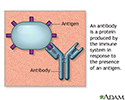
Antibodies - illustration
Antigens are large molecules (usually proteins) on the surface of cells, viruses, fungi, bacteria, and some non-living substances such as toxins, chemicals, drugs, and foreign particles. The immune system recognizes antigens and produces antibodies that destroy substances containing antigens.
Antibodies
illustration
-
Antibodies - illustration
Antigens are large molecules (usually proteins) on the surface of cells, viruses, fungi, bacteria, and some non-living substances such as toxins, chemicals, drugs, and foreign particles. The immune system recognizes antigens and produces antibodies that destroy substances containing antigens.
Antibodies
illustration
Review Date: 8/5/2025
Reviewed By: Jatin M. Vyas, MD, PhD, Roy and Diana Vagelos Professor in Medicine, Columbia University Vagelos College of Physicians and Surgeons, Division of Infectious Diseases, Department of Medicine, New York, NY. Also reviewed by David C. Dugdale, MD, Medical Director, Brenda Conaway, Editorial Director, and the A.D.A.M. Editorial team.
 All rights reserved.