

Intraductal papilloma
Intraductal papilloma is a small, noncancerous (benign) tumor that grows in a milk duct of the breast.
Noncancerous
Benign refers to a condition, tumor, or growth that is not cancerous. This means that it does not spread to other parts of the body. It does not in...

Tumor
A tumor is an abnormal growth of body tissue. Tumors can be cancerous (malignant) or noncancerous (benign).
Read Article Now Book Mark ArticleCauses
Intraductal papilloma occurs most often in women ages 35 to 55. The causes and risk factors are unknown.
Symptoms
Symptoms include:
-
Breast lump, which could be near the nipple
Breast lump
A breast lump is swelling, growth, or mass in the breast. Breast lumps in both men and women raise concern for breast cancer, even though most lumps...
 ImageRead Article Now Book Mark Article
 -
Nipple discharge, which may be clear or bloodstained
Nipple discharge
Nipple discharge is any fluid that comes out of the nipple area in your breast.
ImageRead Article Now Book Mark Article
These findings may be in just one breast or in both breasts. Usually, there is a single intraductal papilloma. In some cases there may be multiple intraductal papillomas.
For the most part, these papillomas do not cause pain.
Exams and Tests
Your health care provider might feel a small lump under the nipple, but this lump cannot always be felt. There may be discharge from the nipple. Sometimes, an intraductal papilloma is found on a mammogram or ultrasound, and then diagnosed by a needle biopsy.
Mammogram
A mammogram is an x-ray picture of the breasts. It is used to evaluate some breast symptoms and to find breast cancer in women with no symptoms (cal...
Biopsy
A biopsy is the removal of a small piece of tissue for lab examination.

If there is a mass or nipple discharge, both a mammogram and an ultrasound should be performed.
A breast MRI is sometimes recommended.
An intraductal papilloma is diagnosed on needle biopsy or surgical biopsy.
Treatment
If a needle biopsy shows an intraductal papilloma, the papilloma may be removed with surgery, or watched over time with exams and imaging.
Outlook (Prognosis)
For the most part, intraductal papillomas do not appear to increase the risk of developing breast cancer.
The outcome is excellent for people with one papilloma. The risk for cancer may be higher for:
- Women with multiple papillomas
- Women who get them at an early age
- Women with a family history of cancer
- Women who have abnormal cells in the biopsy
Possible Complications
Complications of surgery can include bleeding, infection, scarring, and anesthesia risks. If the biopsy shows cancer, you may need further surgery and treatment.
When to Contact a Medical Professional
Contact your provider if you notice any breast discharge or a breast lump.
Prevention
There is no known way to prevent intraductal papilloma. Breast self-exams and screening mammograms can help detect the disease early.
Breast self-exams
A breast self-exam is something a woman does at home to look for changes or problems in her breast tissue. Many women feel that doing this is import...

References
Cox DM, Lippe C, Geletzke AK, et al. Etiology and management of benign breast disease. In: Klimberg VS, Gradishar WJ, Bland KI, Korourian S, White J, Copeland EM, eds. Bland and Copeland's The Breast: Comprehensive Management of Benign and Malignant Disorders. 6th ed. Philadelphia, PA: Elsevier; 2024:chap 14.
Davidson NE. Breast cancer and benign breast disorders. In: Goldman L, Cooney KA, eds. Goldman-Cecil Medicine. 27th ed. Philadelphia, PA: Elsevier; 2024:chap 183.
Weiser R, Klimberg VS, Hunt KK. Diseases of the breast. In: Tyler DS, Hayes-Dixon A, Hines OJ, et al, eds. Sabiston Textbook of Surgery. 22nd ed. Philadelphia, PA: Elsevier; 2026:chap 68.
-
Intraductal papilloma - illustration
Intraductal papilloma is a benign tumor inside a milk duct. Removal of the duct for biopsy may be recommended to rule out cancer.
Intraductal papilloma
illustration
-
Abnormal discharge from the nipple - illustration
Abnormal nipple discharge may be described as any discharge not associated with lactation. The nature of the discharge may range in color, consistency and composition, and occur in one or both breasts.
Abnormal discharge from the nipple
illustration
-
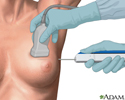
Core needle biopsy of the breast - illustration
A core needle biopsy of the breast is a procedure to remove samples of tissue from a lump or suspicious area of the breast and evaluate it for breast cancer. Core needle biopsy uses a long, hollow needle to take several core samples of tissue, usually using ultrasound or mammographic guidance. The samples are then sent to a lab for analysis.
Core needle biopsy of the breast
illustration


-
Intraductal papilloma - illustration
Intraductal papilloma is a benign tumor inside a milk duct. Removal of the duct for biopsy may be recommended to rule out cancer.
Intraductal papilloma
illustration
-
Abnormal discharge from the nipple - illustration
Abnormal nipple discharge may be described as any discharge not associated with lactation. The nature of the discharge may range in color, consistency and composition, and occur in one or both breasts.
Abnormal discharge from the nipple
illustration
-
Core needle biopsy of the breast - illustration
A core needle biopsy of the breast is a procedure to remove samples of tissue from a lump or suspicious area of the breast and evaluate it for breast cancer. Core needle biopsy uses a long, hollow needle to take several core samples of tissue, usually using ultrasound or mammographic guidance. The samples are then sent to a lab for analysis.
Core needle biopsy of the breast
illustration
Review Date: 10/7/2025
Reviewed By: John Meilahn, MD, General Surgeon, Wyndmoor, PA. Review provided by VeriMed Healthcare Network. Also reviewed by David C. Dugdale, MD, Medical Director, Brenda Conaway, Editorial Director, and the A.D.A.M. Editorial team.
 All rights reserved.