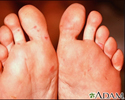


Hand-foot-mouth disease
Coxsackievirus infection; HFM diseaseHand-foot-mouth disease is a common viral infection that most often begins in the throat.
-
Causes
Hand-foot-mouth disease (HFMD) is most commonly caused by a virus called coxsackievirus A16.
Children under age 10 are most often affected. Teens and adults can sometimes get the infection. HFMD usually occurs in the summer and early fall.
The virus can spread from person-to-person through tiny air droplets that are released when the sick person sneezes, coughs, or blows their nose. You can catch HFMD if:
- A person with the infection sneezes, coughs, or blows their nose near you.
- You touch your nose, eyes, or mouth after you have touched something contaminated by the virus, such as a toy or doorknob.
- You touch stools or fluid from the blisters of an infected person.
The virus is most easily spread the first week a person has the disease.
-
Symptoms
The time between contact with the virus and the start of symptoms is about 3 to 7 days. Symptoms include:


-
Exams and Tests
Your health care provider will perform a physical exam. Usually, a diagnosis can be made from asking about the symptoms and the rash on the hands and feet.
-
Treatment
There is no specific treatment for the infection other than symptom relief.
Antibiotics do not work because the infection is caused by a virus. (Antibiotics treat infections caused by bacteria, not viruses.) To relieve symptoms, the following home care can be used:
- Over-the-counter medicines, such as acetaminophen (Tylenol) or ibuprofen (Advil, Motrin) can be used to treat fever. Aspirin should not be given for viral illnesses in children age 18 and younger.
- Salt water mouth rinses (1/2 teaspoon, or 6 grams, of salt to 1 glass of warm water) may be soothing.
- Drink plenty of fluids. The best fluids are cold milk products. Do not drink juice or soda because their acid content causes burning pain in the ulcers.
-
Outlook (Prognosis)
Complete recovery occurs in 5 to 7 days.
-
Possible Complications
Possible complications that may result from HFMD include:
- Loss of body fluids (dehydration)
- Seizures due to high fever (febrile seizures)


-
When to Contact a Medical Professional
Contact your provider if there are signs of complications, such as pain in the neck or arms and legs. Emergency symptoms include convulsions.
You should also contact your provider if:
- Medicine does not lower a high fever
- Signs of dehydration occur, such as dry skin and mucus membranes, weight loss, irritability, decreased alertness, decreased or dark urine
-
Prevention
Avoid contact with people with HFMD. Wash your hands well and often, especially if you are in contact with people who are sick. Also teach children to wash their hands well and often.
References
Dinulos JGH. Exanthems and drug eruptions. In: Dinulos JGH, ed. Habif's Clinical Dermatology. 7th ed. Philadelphia, PA: Elsevier; 2021:chap 14.
Messacar KB, Abzug MJ. Nonpolio enteroviruses. In: Kliegman RM, St. Geme JW, Blum NJ, et al, eds. Nelson Textbook of Pediatrics. 22nd ed. Philadelphia, PA: Elsevier; 2025:chap 297.
Romero JR. Coxsackieviruses, echoviruses, and numbered enteroviruses (EVD-68, EVD-70, EV-A71). In: Blaser MJ, Cohen JI, Holland SM, et al, eds. Mandell, Douglas, and Bennett's Principles and Practice of Infectious Diseases. 10th ed. Philadelphia, PA: Elsevier; 2026:chap 178.